Y hoy en The Economist…y ayer.


Hoy The Economist personaliza. ¿Trata la City de sustituir el Euro por sus Pounds?. Pareciera.

Esto de Londres respecto a la UE, parece como lo de Gibraltar frente a España…una china en el zapato que ya nos dificulta finalizar la tarea emprendida.

Pero no por ello hay que dejar de escucharlos.

The Economist hoy:

EDITADO:

The euro crisis

Spreading from Ireland to Iberia

To stop the euro’s meltdown, Zapatero must revive Spanish reform

Nov 25th 2010 | from PRINT EDITION

HAD Ireland’s government expected to be rewarded by investors after caving in to pressure to seek salvation from the European Union and the IMF, it was soon disabused. So were those who hoped that the crisis engulfing the euro could be contained at the River Liffey. Unlike the relief rally when the EU bailed out Greece in May, investors this time barely paused for breath before continuing to dump Irish assets, as well as those of Portugal and Spain. The euro’s future will be secure only when this contagion is banished. And that, it is now clear, crucially depends on what happens in Spain.

Sigue aquí —>

The Economist ayer:

EDITADO:

The euro crisis

A contagious Irish disease?

The proposed Irish bail-out has not calmed the financial markets. And now their attention is moving on to new victims in the Iberian peninsula

Nov 25th 2010 | DUBLIN, london AND MADRID | from PRINT EDITION

ON NOVEMBER 21st the Irish government at last gave in. It yielded to pressure from its European Union counterparts to seek an emergency bail-out from the EU and the IMF that may amount to as much as €85 billion ($115 billion). In May, when the Greek government secured a €110 billion bail-out and a joint EU/IMF fund worth a stonking €750 billion was put in place, investors believed and the markets rallied. Not this time. Bond yields in Ireland dropped back to 7.93%, but rose to 4.75% in Spain and 11.75% in Greece.

Why? In short, because rescues need a bit of “shock and awe” to convince investors. The bond markets must be startled by the size of the package, persuaded that the authorities will do whatever is needed—and not be invited to doubt it by talk of making investors foot part of the bill in future. They also have to believe that a country’s difficulties concern liquidity (ie, they can repay debt eventually) not solvency (ie, they can’t).

Sigue aquí —>

Y concretamente sobre el dinero depositado en Irlanda. Y no olvidemos que Irlanda, cuando se inició la crisis financiera en USA, y llegaron los primeros síntomas a Europa, se apresuró a GARANTIZAR el 100% de los depósitos bancarios.

EDITADO:

Buttonwood

Plugging the hole

It is easy to put money into Irish banks, but tempting to take it out

Nov 25th 2010 | from PRINT EDITION

RESCUING banks can be like filling a bath with the plug out. It won’t work if water flows out faster than it pours in. Central banks have learned this lesson again and again through history and Ireland may prove yet another case study.

Life is made even more difficult for central banks when they are trying both to rescue their banks and maintain an exchange-rate target. That was true under the gold standard. Back in 1890 Baring Brothers needed a capital infusion of £4m (about £400m, or $640m, in today’s money) when the Bank of England had reserves of less than £11m. There was talk of the suspension of gold convertibility but Britain was rescued by loans of £4.5m from France and Russia.

In the interwar period, the collapse of Credit-Anstalt caused similar problems for Austria. Acting as lender of last resort, the Austrian central bank increased the money supply by 20% virtually overnight. However, far from restoring confidence, this caused a run on other Austrian banks and on the currency; the national bank lost more than a third of its gold reserves. An international rescue effort was able to lend Austria just $15m, less than half the gold lost.

Sigue aquí—>

Creemos que con la entrada de ayer y esta de hoy, nos podemos hacer una idea bastante aproximada de la situación, o al menos de cómo se ve desde distintos ángulos. Ahora cada uno puede sacar sus propias conclusiones.

Haz de guía

Salu2
Publicado en Crisis zona Euro. | 1 comentario

El Jueves que Europa vio en España la “ultima línea de defensa”.


Hoy no tratamos de hacer un análisis profundo de la situación actual, sino de recoger distintas versiones de distintos periódicos de distintas tendencias en relación con el jueves para olvidar que hemos vivido y cuando Europa aún resiste en España.

Los distintos periódicos hacen sus lecturas en la edición del jueves 25, pero muchos hacen referencia al artículo del New York Times de la entrada anterior de este Blog y que apareció en Su portada de ayer.

Nosotros vamos teniendo la sensación, como la tuvimos en mayo, cuando se acuñó la “racista” expresión P.I.G.S. en lo que entendimos como un claro ataque a la propia existencia del Euro. Entendemos que los mercados mercadean, pero también entendemos que estamos en medio de una guerra monetaria a la que se aludió en varios medios el mes pasado, especialmente cuando se auxilió al Dólar, y donde los principales contendientes son EEUU y China y donde Europa podría ser la víctima propiciatoria o el campo de batalla actual.

Lo cierto es que en el pasado mes de mayo era desde la City, desde Londres, desde donde más se atacaba a España, donde se acuñó el término P.I.G.S. –no olvidemos que el U.K. no está en el Euro-, y ahora es Londres la primera interesada en rescatar a Irlanda. O sea, el socio díscolo empieza a tener intereses similares que el resto de la Zona Euro. O en otras palabras, esto se ha ido tanto de las manos, que España se ha convertido, como decía el New York Times, en la última línea de defensa…“Europe can afford the collapse of Ireland, even perhaps that of Portugal, but not that of Spain, so Spain’s ultimate line of defense is in fact this knowledge that it’s too big to fail and that it represents a systemic risk for the euro,” said Pablo Vázquez, an economist at the Fundación de Estudios de Economía Aplicada, a research institute here.

En definitiva, que si la situación es grave, lo cierto es que al final, aquello de que entre todos la mataron y ella sola se murió…y nos referimos al Euro a través de España, que está mal, pero aún así, objetivamente está mejor que en mayo pasado, como se podrá observar en la evolución de los indicadores publicados en el INE, si bien la situación objetiva es la de un nuevo “techo”.

En Libertad Digital:

EDITADO:

El fondo europeo es insuficiente

La UE y el FMI estudian ya un ‘Plan B’ para rescatar a España en caso de quiebra

Los 750.000 millones de euros del Fondo de rescate europeo no serán suficientes en caso de que caiga España. Las autoridades plantean varias opciones para esta situación: ampliar el actual Fondo, préstamos bilaterales, compras de deuda por parte del BCE y quitas soberanas (España suspendería pagos)


image

Sigue leyendo aquí.

En Intereconomía:

EDITADO:

Miguel Martín: »El riesgo de que España sea rescatada reside en que se desate una situación de pánico»

16:35 (25-11-2010) | 2

El riesgo de que España sea rescatada reside en que se desate una situación de pánico. Así lo ha asegurado el presidente de la Asociación Española de Banca en una jornadas financieras organizadas por el IESE.

(…)

El riesgo de que España sea rescatada reside en que se desate una situación de pánico. Así lo ha asegurado el presidente de la Asociación Española de Banca en una jornadas financieras organizadas por el IESE. Para Miguel Martín, sin embargo, esa posibilidad es poco factible, pero pide profundizar en las medidas adoptadas y evitar el efecto contagio.

Recomendamos escuchar el vídeo –no vemos que tenga un código para incluirlo aquí-. Míralo.

En El País:

EDITADO:

La crisis del euro

El BCE abre la puerta a ampliar el fondo de emergencia de la UE para calmar a los mercados

El alemán Weber, máximo aspirante para suceder a Trichet, justifica la medida en la necesidad de garantizar el futuro del euro.- Los inversores temen que los 750.000 millones no sean suficientes si Portugal o España piden un rescate

ÁLVARO ROMERO – Madrid – 25/11/2010

Axel Weber, miembro del consejo del Banco Central Europeo, ha afirmado hoy que el multimillonario fondo de emergencia al que va a recurrir Irlanda para reflotar a su sector financiero y superar sus problemas de deuda, podría ampliarse si se necesita reforzar la confianza en los mercados financieros. «Los 750.000 millones -que se compone este fondo- deberían ser suficientes para tranquilizar a los inversores, pero en caso de que no sea así, se tendrá que aumentar hasta que lo logre», afirmó ayer en París el también director del Bundesbank -banco central alemán-.

Sigue leyendo aquí.

En todo esto, lo realmente asombroso, es que Irlanda haya presentado el miércoles su plan de ajuste, habiendo cerrado la negociación con la UE el domingo, con anuncio de disolución de las cámaras incluido.

¿Debería España plantearse una solución a la alemana?. ¿Un gobierno de concentración?. Y sí, sería posible, claro que sería posible. ¿O aún Spain is so diferent?. Creemos que no, que si España hizo su modélica Transición, es capaz de algo así nuevamente. La cuestión es ¿Será demasiado tarde cuando se plantee?. ¿O lo impondrá la UE?. ¿Y no se podrían concertar los países P.I.G.S con el objeto de crear un contrapoder al EJE franco – alemán dentro de la UE?.

En fin, que esto va a dar mucho que hablar y que la UE debería salir fortalecida de esta, y lo que sí vislumbramos es una pérdida de soberanía hacia una UE más “federalizada”.

Para terminar, hemos de recordar que esto es un verdadero drama humano, la constatación de un fracaso colectivo, y no perder de vista a los que peor lo están pasando. Mañana podría ser Usted.

Haz de guía

Salu2.

Publicado en Crisis zona Euro. | Deja un comentario

Ampliación de capital con aportaciones no dinerarias


Nota del ACTUM de hoy:

EDITADO:

Análisis de las operaciones más usuales

Ampliación de capital con aportaciones no dinerarias

MF 7353, 7296

MFI 7640s.

TSJ Baleares 22-7-10, EDJ 169999

La aportación de un inmueble gravado con hipoteca inmobiliaria con un valor superior al importe del capital ampliado está sujeto a ITP y AJD.

En una ampliación de capital se realizan, en contraprestación, tanto aportaciones dinerarias como no dinerarias- consistentes en bienes inmuebles, unos libres de cargas y uno de ellos valorado en 206.870,63 euros gravado con una hipoteca inmobiliaria con una deuda pendiente de 83.350,63 euros, por lo que dicho inmueble, a efectos de la suscripción de las participaciones sociales, ha sido valorado en 123.520 euros-. La oficina liquidadora efectúa liquidación provisional sobre la base de 83.350,63 euros por considerar, al igual que el TEAR, que se producen dos hechos imponibles: la ampliación de capital, respecto de la cual se presentó la correspondiente liquidación del impuesto, y la transmisión del inmueble con un valor real de 206.870,63 euros, dado que el socio se libera de las deudas que gravan el inmueble. Por su parte el recurrente considera que, en base al principio de especificidad, un mismo hecho no puede liquidarse como transmisión patrimonial y como acto societario.
El TSJ basa su argumentación en el principio de unidad de doctrina asentada con anterioridad, en virtud de la cual, si la aportación no dineraria coincide con el importe del capital ampliado, sólo existe obligación de tributar por la modalidad OS del ITP y AJD. Sin embargo, si además de la ampliación de capital con contraprestación no dineraria, se está realizando una transmisión de un bien por un importe superior al que se corresponde con la ampliación, además de la asunción de la deuda que grava dicho inmueble, el TS entiende que se trata de una operación independiente a la de ampliación de capital y no necesaria para llevar a cabo ésta. En consecuencia, en estos casos ha de estimarse que concurren dos hechos imponibles:
– uno, que se corresponde con la ampliación de capital a cambio de un bien inmueble- sólo por la parte que se corresponde con el importe del capital ampliado-. En este caso, existe obligación de tributar por la modalidad OS del impuesto;
otro, que hace referencia a la transmisión de la parte del inmueble que excede de la ampliación y que implica la asunción de la deuda que recae sobre el inmueble, subrogándose sin novación en las obligaciones de pago del préstamo hipotecario (TSJ Baleares 16-12-09, Rec 70/08).
En consecuencia, dado que la aportación del inmueble no se hizo sólo por el valor del capital aportado sino por más valor, asumiendo la sociedad el pago de la deuda que grava el inmueble- por importe de 83.350,63 euros-, por esa transmisión existe obligación de tributar pro la modalidad TPO del ITP y AJD. Sin embargo, por el importe de 123.520 euros, como se corresponde con el importe de las participaciones sociales suscritas, se ha de tributar por la modalidad OS del impuesto.

(c) 2010 Ediciones Francis Lefebvre

http://www.efl.es/

Haz de guía

Salu2.

Publicado en Tributario | Deja un comentario

España en el New York Times del Thanksgiving Day 2010…a la espera de “la reunión”


La portada del New York Times de hoy vine protagonizada por tres asuntos de alcance, la reacción de Korea del Sur después de ser bombardeada por la “otra” Korea, el “vértigo” sobre España y el riesgo para el Euro y…el THANKSGIVING DAY, o los pasteles recomendados para este día festivo “civil” en USA.

Editamos a continuación la primera parte del artículo sobre España, pudiendo seguir la lectura de la segunda parte en el enlace que hay al final.

EDITADO:

NEWS ANALYSIS

Fears Mount Over Spain, and Risks to the Euro

By RAPHAEL MINDER
Published: November 24, 2010

MADRID — Europe so far has survived the bailout of Greece. The financial rescue of Ireland also is manageable. Even if Portugal becomes the third country to succumb and seek aid, as many people widely predict, it is unlikely to push Europe to the financial brink.

Enlarge This Image

Daniel Ochoa De Olza/Associated Press

A broker on the floor of the stock exchange in Madrid on Wednesday.

Enlarge This Image

Juanjo Martin/EFE, via European Pressphoto Agency

Elena Salgado, Spain’s finance minister, right, and Alfredo Pérez Rubalcaba, a deputy prime minister, at a meeting about employment this month.

But any bailout of Spain — with an economy twice the size of the other three combined — could severely stress the ability of Europe’s stronger countries to help the financially weaker ones, and spell deep trouble for the euro, Europe’s common currency. Even though Spain, like Ireland, has adopted an austerity plan to help it avoid the need for a bailout, it still could need aid if its banking system proves frailer than the government thinks it is, as was the case in Ireland.

This troubling possibility has unnerved lenders, with Spain’s borrowing costs rising even though Madrid has cut its deficit and the country’s banks maintain they have sufficient strength to absorb their bad real estate loans. “Europe can afford the collapse of Ireland, even perhaps that of Portugal, but not that of Spain, so Spain’s ultimate line of defense is in fact this knowledge that it’s too big to fail and that it represents a systemic risk for the euro,” said Pablo Vázquez, an economist at the Fundación de Estudios de Economía Aplicada, a research institute here.

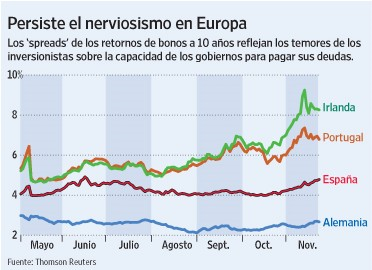
Reflecting the worries of investors, the yield spread between Spanish 10-year government bonds and those of Germany continued to widen on Wednesday — to as high as 2.59 percentage points, the biggest gap since the introduction of the euro. Spreads typically widen when investors perceive greater risk of not being repaid.

The problem for Spain is one of “self-fulfilling expectations,” said Jordi Galí, director of the Center for Research in International Economics at Barcelona’s Pompeu Fabra university. “If investors expect Spain to have trouble refinancing its debt, now or somewhere down the road, then Spain will have trouble,” he added. “This is only aggravated by the fact that the reluctance of investors to purchase the country’s public debt leads to an increase in the interest rate it has to pay and thus in the budget deficit and the amount of debt it has to issue.”

Elena Salgado, Spain’s finance minister, insisted on Wednesday that Spain would not need rescuing. She told Spanish radio that “we are in the best position to resist against these speculative attacks.” Indeed, some say that one of Spain’s relative strengths is that a large amount of its government debt — 203.3 billion euros ($271.1 billion) — is owed to its own banks, rather than foreign lenders. If the government’s financial condition worsens, the thinking goes, Spanish banks would have a greater incentive to help out by easing terms on the loans than would foreign banks, which might take a harder line.

Of course, it is a bit of a double-edged sword; if the Spanish banks need to ease terms to help the government, they could be forced to swallow steep losses, hurting their balance sheets.

The likelihood of entering such a vicious circle could also rise next year, when Spain is due to repay lenders 192 billion euros, or about a fifth of the total debt. As a result of increasing interest it would have to pay for new borrowing, Spain faces a rise of 18 percent in the cost of financing its debt, according to the government’s budgetary plan.

Investor nervousness is mounting just as Madrid is reining in a budget deficit that reached 11.1 percent of gross domestic product last year. Prime Minister José Luis Rodríguez Zapatero, initially slow to recognize the crisis, narrowly pushed through Parliament last May an austerity package that included 15 billion euros of spending cuts. As a result, Spain’s central government deficit fell 47 percent in the first 10 months of this year, according to government figures released on Tuesday.

Ireland also made steep spending cuts, but still needed a bailout. The main reason is that its banks were a lot more troubled than the government realized, and it could not afford the cost of supporting them without help from Europe.

The looming question is whether Spanish banks are really as healthy as the government and the banks say they are.

Y la segunda parte sigue aquí.

El Inglés no es un problema, ve a cualquiera de los traductores y te arreglan gran parte de la cuestión, otra cosa es la interpretación. Te recomendamos para la traducción, así, de pronto, pues lo fácil, el Traductor de Google.

Feliz THANKSGIVING DAY. Por cierto, hoy es el Día Internacional Contra la Violencia de Género.

destac

Haz de guía

Salu2.

Publicado en Crisis zona Euro. | Deja un comentario

The Cove. El lugar donde Japón aún mata delfines.


Este es un esfuerzo que realiza un equipo por descubrir, gravar y denunciar la matanza de delfines en Japón, algo totalmente secreto y para lo que hubo que organizar una operación civil, con técnicas militares.

Como no es nuestro el protagonismo, si quieres leer más, sigue aquí. Y recomendamos visitar el Blog que hay en la web.

Te dejamos aquí un par de vídeos donde podrás ver el primero con tranquilidad y para el segundo, necesitarás algo más de tiempo.

Y aquí el segundo vídeo:

O este otro, que se abrirá al hacer clic en el siguiente enlace y solo dura 1,05 minutos:

http://content.bitsontherun.com/players/79nPcj59-zwh6UA33.swf

También te recomendamos visitar estos dos sitios relacionados:

http://www.takepart.com/thecove

El oficial: http://thecovemovie.com/

Conmovedor.

Haz de guía

Salu2

Publicado en El mar, o la mar | Deja un comentario

La crisis de deuda irlandesa, por The Economist


Hoy, tan solo reproducimos:

EDITADO:

The euro-zone crisis

Saving the euro

Ireland’s woes are largely of its own making but German bungling has made matters worse

Nov 18th 2010

HERE we go again. Barely six months since Greece was bailed out, a familiar story is emerging. Investors nervous about a small European country with ballooning debts and uncertain prospects, start selling its bonds. A surge in bond yields infects other countries in a similar (if less urgent) bind. A looming local poll—this time a by-election in Donegal—feeds the doubts. The mixed messages and bungling of Germany’s politicians plunge a bad situation into outright peril.

And three horribly familiar questions emerge. Who is to blame for this mess? What is the way out? And what on earth does it mean for the euro, the common currency at the heart of the world’s biggest economic region? At least there are limits to the parallels with Greece; Ireland is more likely to generate the growth that will one day allow it to service its debts.

Rum, solvency and the crash

Related items

On the first question, the original sin lies with Ireland. The Celtic tiger roared ahead, but it paid too little attention to its gung-ho banks and asset markets. A property bubble blew up, and Ireland became dangerously dependent on the revenues that flowed from it. The country’s financial regulators were incompetent at best, cronies at worst. And at the first sign of trouble, the government made the mistake of issuing a blanket guarantee for all its banks’ debts, which now means that taxpayers have to bear the catastrophic losses on property bets made by Anglo Irish Bank and others, pushing the budget deficit to 32% of GDP this year (see article).

So Ireland has long been flirting with a debt crisis of its own. But it has not been helped by the other euro-zone members. To begin with, the rescue of Greece was a botch: it fudged the obvious issue that Greece will never fully be able to repay its debts on time. And the temporary support scheme cobbled together for the rest of the euro zone was equally flawed: in particular, it was too easy on private creditors. But although all this was troubling, Angela Merkel’s attempt to fix it has been spectacularly clumsy.

At an EU summit at the end of October the German chancellor won agreement that any future euro-zone rescue scheme should include a mechanism for an orderly sovereign-debt default. The principle was absolutely right: unless default is a possibility, bond investors have no reason to distinguish between good and bad credits. But the idea of making bondholders lose money when sovereign credits turn sour was aired without any guidance about how and when it might apply. Astonishingly, the Germans failed to put together a detailed proposal for the summit.

The timing was dreadful, with Ireland, Greece and Portugal trying to fashion austere budgets for 2011. Bond investors were invited to fear the worst. Ever since, the Irish have been on the run, and the Greeks and others on tenterhooks. An Irish problem has quickly become a euro-zone problem—and a British headache, too, given the close links between the neighbours.

The second question—the solution—shows how different Ireland in fact is from Greece, which was pleading for money from a reluctant Mrs Merkel. This time the argument is between the Irish, who have insisted they do not need a bail-out, and large euro-zone countries which insist they must take one.

Both sides are being disingenuous (see article). The Irish are right that they have enough money to last until the middle of next year (the treasury has around €20 billion of cash squirrelled away). But they could face bank runs long before then.

On the other hand, the Irish are also right to be suspicious of intentions in Brussels and Berlin. Too much of the EU’s motivation seems to be to punish Ireland for its Anglo-Saxon ways—especially its highly competitive 12.5% tax rate on corporate profits, which helps it attract foreign firms. Raising this would be madness. Ireland is planning budget cuts for next year of 3.8% of GDP; any economy would struggle against that headwind. But its hopes are anchored in those new foreign arrivals. The sort of foreign direct investment (FDI) on which the prosperity of the 1990s was built is flooding in once again. IDA Ireland, the agency that targets such investors, says FDI in 2010 will be the best for seven years. A new generation of firms, including computer-gaming outfits like Activision Blizzard and Zynga, are joining the established operations of Intel and Google. Ireland’s workforce is young, skilled and adaptable. Rents are coming down even faster than wages.

If only both sides gave up posturing, they would agree that the European rescue funds should be used to stabilise Ireland’s banks, insisting only on certain budget targets in return. Such a deal should satisfy Ireland’s euro-zone partners, which want an end to the uncertainty, and the European Central Bank (ECB), on which Ireland’s banks have become overly reliant for funding. It would also be wise to offer a similar deal to Portugal. Its banks are dependent on ECB support, and it too is in the bond markets’ sights.

Green and bear it

That leaves the third question: the euro. For all the talk of the euro failing to survive this sovereign-debt crisis, it should struggle through. Despite the troubles on its periphery, the public debt of the euro zone as a whole is not notably high by rich-country standards. The real problems are the absence of a credible plan to deal with errant countries (as the Germans have recognised), the structural imbalances between Germany and the less competitive southern members and, most of all, the miserable growth prospects for those poorer, weaker southerners, made worse by their fiscal retrenchment. Denied the possibility of devaluation, slow-growing countries like Portugal and now Spain should be looking for structural reforms that can reduce their labour costs, enhance enterprise, stimulate competition and regain competitiveness.

Ironically Ireland looks more likely to find that growth than the Mediterranean countries. None of that excuses the mess it has made of its banking system. But the real question for Europe is whether it wants a slow succession of Greeces and Irelands—or whether it is ready to move beyond government rescues and focus on growth.

Leaders

El original aquí.

Y si te queda tiempo para oír los 10 minutos del vídeo en que nos lo cuentan, en Inglés en el mismo enlace, titulado Ireland´s economics troubles.

Haz de guía

Salu2.

Publicado en Crisis zona Euro. | Deja un comentario

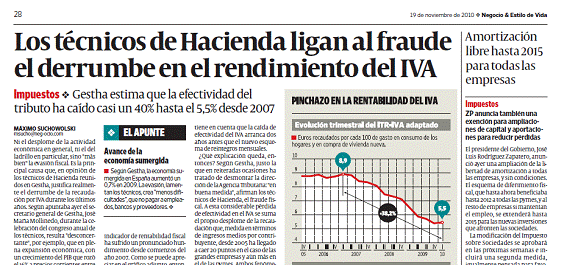
La culpa de la caída del rendimiento del IVA…¡¡¡del fraude!!!, como no…jejeje…pero no de la caída del consumo o de la subida del tipo impositivo…peeerooo…¿Se puede tener tanta…?


Andaaa…yaaa…es lo que nos pide el cuerpo decir. Se puede tener tanta.

clip_image002

Afirman los Técnicos de Hacienda ligan al Fraude el derrumbe del rendimiento del IVA, y casualmente, esta noticia la recibimos el mismo día que se publican los datos trimestrales en el INE.

Y claro, unos días después de saber que el Índice de Producción Industrial (IPI), sigue dándonos cifras negativas, unos días después de que conociéramos que se vuelve a estancar el crecimiento del Producto Interior Bruto (PIB), casi un mes después de conocer las sospechosamente contradictorias cifras de la EPA, poco más de dos meses después de conocer que el coste salarial sigue aumentando, poco menos de un mes después de conocerse que las cifras relativas a las hipotecas siguen disminuyendo. No lo entendemos, no.

La caída del IVA no tiene que ver con el consumo, no, ni con la subida del IVA, no, tampoco, siempre la culpa es del ciudadano.

Sólo el turismo nos da alguna alegría en estos nuevamente aciagos días, cuando Irlanda discute con la UE cómo será su rescate, cuando Portugal ya ha “pulsado el botón del pánico” y sin embargo, Nuestro Gobierno sigue hablando deprimeros indicios de recuperación”.

En fin, que creemos que ya que las barbas arden, que vemos las nuestras en peligro, al menos deberíamos poder tener la seguridad de que quien va al timón sabe en qué temporal estamos, que cuando uno va al médico le gusta ponerse cómodo y que le digan la verdad, sólo eso, solamente eso y nada más que eso. Porque…¿Con bonitas palabras se van a animar los mercados?. Los mercados esto lo conocen, y nosotros, el pueblo también, hay libertad de prensa y de comunicación y banda ancha de internet.

Si nos vamos a tener que apretar aún más, que nos digan quién nos toca al lado, que no se nos trate de engañar ¿Con qué objetivo?. No lo entendemos, sinceramente, pareciera que alguien se estuviera haciendo trampas al solitario.

clip_image004

Pero no son solo malas noticas, en esta ocasión nos las han aderezado algo, aunque no sabemos aún cuánto de agri tienen más que dulces, pues nos anuncian la extensión de la libertad de amortización hasta 2015, nos anuncian una nueva Reforma de la Ley Concursal, que debió estar lista en mayo pasado y en la que nos encontramos, al tiempo, lindezas tales como la Ley de Jurisdicción Social, donde se pretende “centrar en los juzgados de lo Social todos los conflictos de carácter laboral”, o sea, volver a desmembrar el procedimiento concursal…volvemos a la situación anterior a la Ley Concursal. ¿Es esto otra concesión a los sindicatos?.

Al mismo tiempo se desempolva el baúl de los recuerdos y nos sacan nuevamente la Nueva Ley de Servicios Profesionales “para aumentar la competencia en sectores como, por ejemplo, la abogacía, los auditores, ingenieros o arquitectos”.

Pero además, y nuevamente en relación con la concertación social se nos dice que hay “deseo de que la patronal y los sindicatos lleguen a un acuerdo sobre la negociación colectiva, aunque si no es así, será el Gobierno el que presente su propuesta”. ¿Les suena esta cantinela?.

A armarse de paciencia, que la precampaña electoral ya está siendo muuuy larga, y lo que queda hasta 2012.

Haz de guía

Salu2

Publicado en Tributario | Deja un comentario

Divertidos…


Un amor imposible:

Y un ejemplo de cómo trabaja un «equipo emprendedor«:

Haz de guía

Salu2

Publicado en Humor | Deja un comentario